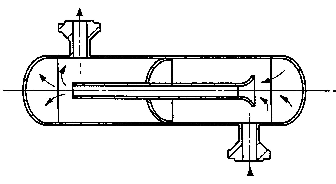
Counterflow offers pulsation dampening design to API 618 using Design Approach 1 for pulsation control through the use of our proprietary software program.
|
Reciprocating compressors should be fitted with devices to smooth out, or dampen pressure pulsations created by the act of compression where suction and discharge valves are open for only part of the compression cycle. Pressure pulsations can create vibration in the piping system, and makes the accurate indication and measurement of pressure difficult to achieve. Pulsation dampeners for reciprocating compressors generally take the form of a cylindrical vessel with end caps. The vessel may contain internal baffles.
| |
Volume Bottles
The simplest form of a pulsation dampener is a volume bottle, sometimes called a surge drum. A volume bottle is a pressure vessel without internal baffles and is usually mounted directly to the compressor cylinder connection, either suction or discharge.
Benefits
• Ease of Construction
• Low Pressure Drop
Disadvantages
• Difficulty in accurately predicting pulsation levels
• Achieving low pulsation levels without resorting to oversized vessel
A generally accepted formula for determining the size of volume bottles for application up to 600 psi is 5 times the cylinder swept volume for discharge bottle, and 7.5 times the cylinder swept volume for suction bottle. Typically, this method of calculating the size of the dampener for a compressed air system will provide pulsation dampening to within + or - 5% absolute pressure, but cannot be relied upon.
|
Dampeners with Internals
A pulsation dampener with internal baffles, sometimes called a snubber, is much more predictable in its performance since its design takes into account specific compressor duty, including speed and gas composition. The internal baffling generally consists of a baffle plate and choke tube. Care must be taken to arrive at the optimum pulsation dampening level without creating unacceptable pressure drops. This type of dampener can typically limit pressure pulsation to within + or - 2% of absolute pressure while at the same time limiting pressure drop to 1% of absolute pressure.
|
Pulsation Dampeners in OXYGEN Service
Special consideration must be given to the design and installation of gas pulsation dampeners in oxygen service. The presence of, or the potential to entrap oil and dirt can have a detrimental effect on an oxygen installation.
|
| Pulsation dampeners should, wherever possible, be designed without internal baffles and choke tubes; and nozzles should be welded flush with shell inside diameter and not protude through the shell as is the normal design custom with many other gasses. Oxygen service vessels and pulsation dampeners require inspection ports larger than the minimum required under ASME Section VIII. These are required for both visual inspection and access for special cleaning processes necessary to insure 'oxygen clean' conditions before entering service.
|
For a prompt design calculation and quotation, please print out the .pdf form below with as much information as known and fax it to 814-734-1797 or email to counterflow@msn.com. If you do not have Adobe Reader you can get it here.
|
|